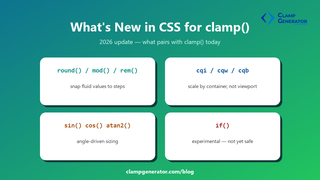
clamp() itself hasn’t changed, but several newer CSS features change what you can feed into it or do with its output. Here’s what’s actually useful to pair with clamp() today, and what to still treat as experimental.
Container query units (cqw, cqi, cqb, cqmin, cqmax)
Baseline widely available. These resolve against a containing element’s size instead of the viewport, so a clamp() inside a reusable component scales correctly no matter where that component is dropped on the page:
.card { container-type: inline-size; }
.card h3 { font-size: clamp(1rem, 5cqi, 1.5rem); }
Use cqi/cqw in place of vw whenever the element isn’t guaranteed to span the full viewport — this is already covered in more depth in our clamp() special cases guide.
round(), mod(), and rem()
These math functions let you post-process a clamp() result instead of accepting whatever decimal it produces:
/* snap a fluid value to the nearest 0.25rem step */
padding: round(clamp(1rem, 4vw, 3rem), 0.25rem);
Useful when a design system wants fluid scaling that still lands on fixed spacing steps (4px/8px grids, type scale increments) rather than an arbitrary fractional pixel value.
Trigonometric functions (sin(), cos(), atan2(), etc.)
Also broadly supported now. On their own they’re not a clamp() replacement, but they’re useful alongside it for angle-driven sizing — for example, deriving a width from a rotation angle, then still bounding the result with clamp() so it never collapses to zero or runs away at extreme angles:
width: clamp(2rem, calc(10rem * sin(var(--angle))), 10rem);The if() function — not yet safe to rely on
CSS has an if() conditional function in active development that would let a declaration branch on a condition directly in CSS, rather than needing a custom property trick. It’s a genuinely new capability, but support is inconsistent across browsers right now. If you’re exploring it, keep a clamp()-only fallback declared first — CSS uses the last valid declaration, so unsupported browsers keep the fallback while supporting ones take the if() version.
What hasn’t changed
clamp()’s own syntax and resolution — clamp(MIN, VAL, MAX) = max(MIN, min(VAL, MAX)) — is stable and has been Baseline since 2020. Nothing above replaces it; they all extend what you can put inside it or do with what it produces.